…becoming a grandpa. No, I’m not old enough but little Jesse Paul is perfect!
“We must seek to balance security with passenger convenience,” said EU Transport Commissioner Jacques Barrot. “In this case it is clear that the inconvenience of additional limits would outweigh the advance in security.
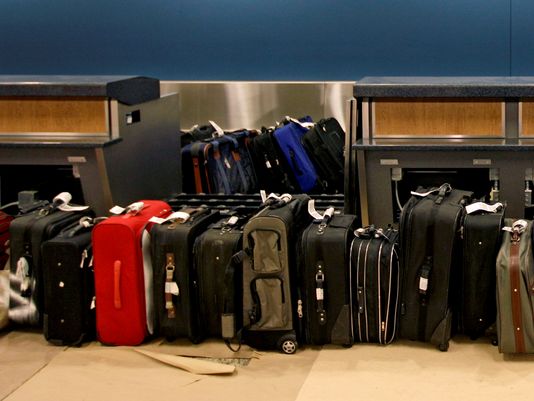
In the wake of an alleged August 2006 plot against civil airplanes in Britain, security experts recommended that the European Commission limit the maximum size of carry-on bags to 56 by 45 by 25 centimeters.
The measure was originally supposed to take effect in May 2007, but the European Union’s executive arm put it off a year while it conducted studies to see if it was really worthwhile, which it was not deemed to be.
The studies found that baggage size had little impact on the performance of airport security staff.” -AFP
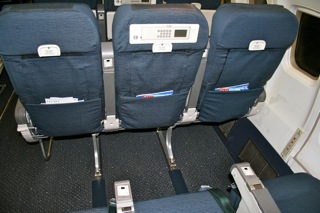
As travelers have adjusted to the carry-on liquid rules the overhead bins are back at full capacity. This definitely commends soft-sided, legal-or-smaller-sized bags:
On her US Airways flight from New Orleans to Washington in March, Corinne Marasco, a science writer from Kingstowne, Va., was forced to check her small wheelie bag at the gate because no room remained in the overhead bins.
It didn’t matter that the gate agents kept reminding passengers that they were limited to one item of carry-on luggage, plus one personal item; the overhead bins were stuffed with shopping bags, knapsacks and pieces of luggage that clearly didn’t pass the size test.
“I saw a woman with a roll-on suitcase, a medium-size tote bag and a pocketbook board the plane, and no one asked her to check the suitcase,” Marasco said. “I was sorely tempted to start emptying out the bin over my seat so I could fit my suitcase in. - NYT via Kansas City Star
The above story also suggests that the fees airines are levying for checked luggage is driving more inexperienced, rule-flouting flyers to carry on.
TSA Approves Use of Tamper-Evident Bags for Duty Free Liquids for Flights Leaving the U.S.
May 1, 2008
TSA Public Affairs
WASHINGTON - The Transportation Security Administration (TSA) announced today its approval of security tamper-evident bags for the transportation of duty-free liquids, purchased post-TSA security, on flights departing the United States for international destinations. Tamper-evident bags must meet International Civil Aviation Organization (ICAO) guidelines.
“The use of tamper-evident bags is another step in harmonizing security measures with our international partners,” said TSA Administrator Kip Hawley.
Tamper-evident bags are for passengers departing the United States who have purchased duty-free liquids in the secure area of U.S. airports. Tamper-evident bags will not be accepted in the United States at security checkpoints. International travelers arriving in the United States are reunited with their checked bags and have the opportunity to store liquid duty-free items before their next flight. Travelers exiting the United States, arriving at a non-U.S. international airport, and continuing on to a final international destination may not be provided this same opportunity as their bags go directly to their final destination. 
The use of tamper-evident bags on U.S.-departing flights is an additional security measure that will align with European Union security protocols and will reduce the number of passengers who surrender duty-free liquids when transferring to European or other international airports. This is part of ongoing TSA efforts to harmonize security measures with transportation security partners around the world.
Vendors of duty free liquids will voluntarily begin using these bags during the coming days and weeks.
There is something new under the sun: the Zuca Pro roller is a radical bag that offers some unusual features and an eye-popping design. I can’t tell from the website info whether it may be a good one-bag solution or not. The interior room is somewhat under-sized and there are no dimensions given for the packing cubes. Still, it is intriguing. It offers a cabinet-like modular interior and is rigid enough to serve as a seat - try that with your backpack. Pricing ranges from $235-$285. I’ll be on the hunt for more info on the Zuca Pro…DHS Announces New Aviation Security and Traveler Screening Enhancements
April 28, 2008
BALTIMORE– The U.S. Department of Homeland Security (DHS) announced today improvements aimed at strengthening aviation security while decreasing the hassle factor for travelers. Among the key improvements, DHS is providing airlines more flexibility to allow passengers to check in remotely who have been unable to do so because they have a name similar to someone on a watch list. The department also unveiled the Checkpoint Evolution prototype, which begins full operation at Baltimore-Washington International Airport (BWI) today.
Each airline will now be able to create a system to verify and securely store a passenger’s date of birth to clear up watch list misidentifications. By voluntarily providing this limited biographical data to an airline and verifying that information once at the ticket counter, travelers that were previously inconvenienced on every trip will now be able to check-in online or at remote kiosks.
“Hassles due to misidentification and the resulting necessity to stand in line to check in at the ticket counter is consistently among the deepest – and most valid – complaints of the traveling public,” said Homeland Security Secretary Michael Chertoff. “Thousands of passengers are inconvenienced each day, and this change should provide a way to eliminate the vast majority of these situations. This is good for travelers and for security, because as we make the checkpoint environment calmer, it becomes easier to spot individuals with hostile intent.”
Additionally, DHS is providing greater clarity on the types of identification that will be accepted at checkpoints in the U.S. Beginning May 26, 2008, federal or state-issued photo ID will be accepted if it contains: name, date of birth, gender, expiration date and a tamper-resistant feature. Standardizing the list of accepted documents better aligns TSA with other DHS components and REAL ID benchmarks. More information on acceptable documents is available at www.tsa.gov.
These innovations, along with the new Checkpoint Evolution prototype, are part of a broader effort to calm the checkpoint. The BWI prototype includes Millimeter Wave technology used in random continuous use, multi-view X-ray and liquid bottle scanners. These technologies, in conjunction with changes to the checkpoint environment and processes, will be evaluated for operational efficiency over the coming months.
Transportation Security Officers and managers at BWI are the first in the country to complete a 16-hour training module designed to incorporate the latest intelligence analysis, more advanced explosives detection skills, and ways to engage with passengers to promote a calmer environment for better security. The training was developed by the Transportation Security Administration (TSA) Office of Intelligence, Bomb Appraisal Officers, and TSA Checkpoint Evolution team.
Checkpoint Evolution is located at B Checkpoint, Southwest Terminal at BWI. The layered security elements are both modular and flexible and designed to work individually, as well as part of an integrated package.
Read how an Aussie family goes light and right around the world:
“Travelling light means washing our “smalls” each night, inventively hanging them on wheelie-bag handles and other protrusions to dry. In retrospect, with clean, dry hiking socks at a premium, colour coding would have been a good idea. Fortunately, as hoped, our natural fabric clothing, of silk, cotton and wool, withstands several wears before requiring washing - and, between B&Bs and hotel lodgings, friends kindly show us their washing machines as well as the sights.” - article here
An excellent look at the bundle packing method may be found here from lifeapps. You may also see our post with diagram.
What brand of carry-on luggage do you use | |
| Selection | |
| eBags | 15 votes |
| Samsonite | 10 votes |
| Tough Traveler | 2 votes |
| Tom Bihn | 39 votes |
| Red Oxx | 47 votes |
| MEI | 11 votes |
| Victorinox | 7 votes |
| Briggs & Riley | 6 votes |
| Travelpro | 8 votes |
| American Tourister | 7 votes |
| Rick Steves | 10 votes |
| Eddie Bauer | 2 votes |
| Orvis | 0 votes |
| Filson | 3 votes |
| Boyt | 0 votes |
| Tumi | 6 votes |
| Eagle Creek | 14 votes |
| Patagonia | 7 votes |
| Jansport | 4 votes |
| OTHER | 24 votes |
No real surprises here. The quality leaders (Red Oxx, Tom Bihn, and Eagle Creek) and the value leaders (Rick Steves and eBags) have made strong showings. Vote in the right-hand column of this page if you haven’t done so.
April 2 marked OBOW’s one-year anniversary. 297 posts and lots of new friends later we’re going strong with significant gains in traffic in the last several weeks. We’ve added the reader forum in recent weeks and hope to rely heavily on reader contributions in 2008. You guys are the real experts! Thanks for a great first year.The Millimeter Wave is about to hit both coasts:
TSA Announces Bi-coastal Launch of Millimeter Wave Imaging Technology
Press Release
TSA Public Affairs
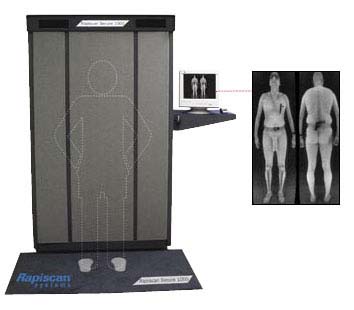
WASHINGTON – The Transportation Security Administration (TSA) announced today pilots of millimeter wave technology to Los Angeles International Airport (LAX) and John F. Kennedy International Airport (JFK). Millimeter wave is currently in use at Phoenix Sky-Harbor International Airport. Millimeter wave detects weapons, explosives and other threat items concealed under layers of clothing without any physical contact. It is a promising alternative to the physical pat-down.
“The use of whole body imaging is a significant step forward in checkpoint technology,” said TSA Administrator Kip Hawley. “By expanding the use of millimeter wave, we are providing our officers with another tool to enhance security and protect the public from evolving threats.”
At LAX, millimeter wave will be used in a random continuous protocol. Alternative screening measures will be offered to individuals who decline to go through millimeter wave when asked to do so. The LAX pilot enables TSA to examine millimeter wave’s operational capability, throughput, training, ease of use and privacy perceptions by the traveling public. The metal detector will remain in place at the checkpoint. The passenger will pass through it after going through the millimeter wave machine.
Millimeter wave at JFK will be piloted as a secondary screening device similar to its use in Phoenix. The technology is a voluntary alternative to a pat-down during secondary screening. During the Phoenix pilot, 90 percent of passengers have chosen the technology over the traditional pat-down.
In both locations, a transportation security officer will guide passengers through the process, which involves stepping into the machine and remaining still for a matter of seconds while the technology creates a three-dimensional image of the passenger from two antennas that simultaneously rotate around the body. Once complete, the passenger will step through the opposite side of the millimeter wave portal.
To ensure privacy, security officers view images from a remote location. From this location, the security officer cannot ascertain the identity of the passenger, either visually or otherwise, but can communicate with a fellow officer at the checkpoint if an alarm is presented. A security algorithm will be applied to the image to blur the face of each passenger, further protecting privacy.
Millimeter wave uses electromagnetic waves to generate an image based on the energy reflected from the body. Active millimeter wave technology passes harmless electromagnetic waves over the human body to create a robotic image. It is safe and the energy emitted by millimeter wave technology is 10,000 times less than a cell phone. TSA recently announced it will purchase and deploy 30 more of the machines this year.
TSA blog defends the Wave:
As a married father of five small children, I wouldn’t think twice about sending my wife, my four boys or little girl into this machine. I’ve seen the image it produces and I am not only confident as a TSA employee - but as a citizen - that TSA has done everything possible to address passengers’ privacy concerns regarding whole body imaging.
For those of you who remain skeptical, you’ll be happy to know that, as we expand the use of whole body imaging to JFK and LAX, it remains an optional screening method for passengers. It’s voluntary so if you’re selected for additional screening and you prefer the physical pat-down, just let our officers know. - read the whole post here and don’t miss the comments!
The ultralight, ultrathin Macbook Air has some serious PC competition: the 3.13-pound Lenovo X300. Though thicker and slightly heavier than the MBA, the X300 has more features. Neither are cheap; the less it weighs, the more you pay. From slashgear.com:
“It’s hard to imagine that there are people out there who would seriously draw the line at carrying the scant extra millimetres of the X300 over the MacBook Air, and so a decision comes down to OS X versus Vista and what connectivity you demand from an ultraportable. With superlative build quality, usability not impacted by its scant dimensions and enough grunt, if not for the sort of CPU intensive tasks you might ask a desktop PC to handle, then for all the everyday use you could want of it, it ticks more boxes than any of its rivals. Yes, the price - currently from $2,997 direct from Lenovo - puts the X300 resolutely into the premium category, but spec a MacBook Air with SSD, ethernet and external DVD and you’ll be paying Apple pretty much the same amount. And while the Air might have the gloss factor, it’s the X300 that, quietly but certainly, edges ahead.”
Randy S. posted this excellent account (on the (Tom Bihn forum) of a successful transition from wheeled luggage to convertible bag:
“This is my first field test for my new Brain Bag and Aeronaut.
After hearing Leo Laporte rave about his Tom Bihn bags, I rushed to the website and immediately bought a Brain Bag to hold my 17” MacBook Pro and all of the associated stuff that comes along with it. I got the recommended Brain Cell to provide added support for the laptop, and perhaps act as a carry case when I don’t want the whole bag.
I’m a road-warrior, logging between 50 and 100 flight segments a year, mostly domestic US. I had been swearing by my Eagle Creek Switchback, using the daypack as my personal “laptop bag”. However, more than once, my laptop floating around loosely in the daypack has gotten cosmetically damaged.
The Brain Cell is a welcome change! It fits very nice, and the clips hold it well in the Brain Bag, to keep it all from coming apart as I (frequently) pull the laptop out for use or inspection at flight checkin. I also got a Snake Charmer, and can’t imagine working without that convenience now. I put the power cord in one side, and everything else in the other, so that I can easily pull out the power cord without it being tangled in everything else.
After using the Brain Bag for a couple of weeks, I decided I wasn’t ever going back to my Eagle Creek, so now I needed “the clothes bag”. Based on the “One Bag” site’s info about how much space and weight the wheels take up, I decided to try a non-wheeled approach for for the first time in years. This was a brave move, but boy, am I happy with the results.
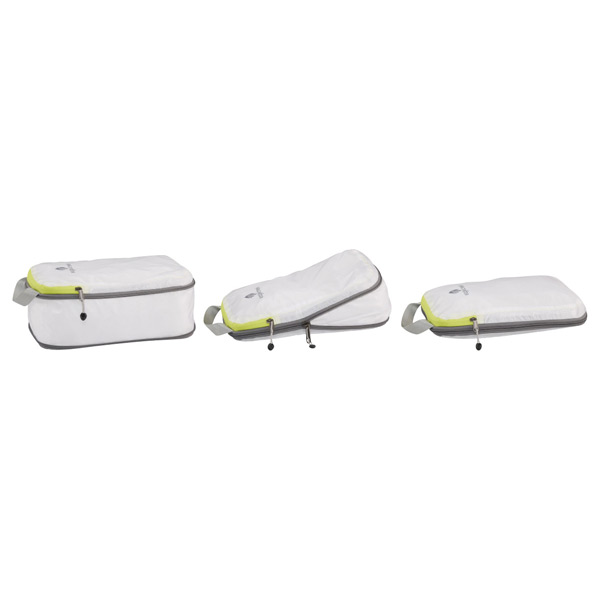
I picked up the Aeronaut, opting for the smaller-frame backpack since I’m a small (but round) guy, and I don’t think I’ll be backpacking often with this. However, I stepped up to the Absolute Comfort shoulder strap, knowing that my back would be holding the Brain Bag while my shoulder (and neck) would be supporting the Aeronaut. I got a full size packing cell, two half size, and two small end-cap size cells, as recommended. (I’m still sorting out how to use these best.)
After packing the Aeronaut with my usual “reusable one week of clothes”, I couldn’t believe it… I still had space left over, and I could easily support the bag with one hand! My Eagle Creek rollaboard was never this light, even packed with a light loadout.
But the best part was on the outbound leg of this trip I’m currently on, to Brazil. My Delta flight from Portland to Atlanta got an hour weather delay, leaving me 15 minutes to get from the T concourse to the E concourse for my international leg. (Many of you reading know what this is like, I presume.) So, I grabbed the Brain Bag, and threw it on my back, and then slung the Aeronaut over my right shoulder and neck. I slung the bag forward in front of my waist, and grabbed both handles to reduce the weight on the neck. I ran like this to the tram, trammed to E, and then ran the rest of the way down to E1. Even carrying this, rather than rolling, it was still less effort, and I was especially happy not to need a double-wide space that the roller took. I might have looked a bit funny running with a big backpack sticking out my back, and a fullsize carryon in front of my stomach, but it worked, and that’s all that mattered to me.
I made my flight, and as I was getting settled in, I had just one small space over my seat to put my bag, the other spots already claimed by those that had a more leisurely connection. My Eagle Creek with its hard back would not have fit, but the Aeronaut fit nicely by “giving” just a bit since the sides are entirely soft. Again, a win for the Aeronaut. (If you’ve ever fought the center overhead storage in business class on a 757, you know the problems there, especially when someone else has a large rigid barely legal bag.)
So far, I’m very very happy… ” - original post
More from Randy:
I’ve found that even though I look a bit like an oddly shaped Sherpa, the best way to carry my load was having the weight both in back and in front directly. I put my rather heavily packed BrainBag on my back (using the waist belt for longer distances) and I sling the Aeronaut around my right shoulder and neck but hanging immediately in front of my waist. Distributed this way, I found that I could walk rather long distances without having to relieve the shoulder strap weight of the Aeronaut, although I would grab the Aeronaut by the end handles when I was standing in line occasionally to reduce the neck pull. One other advantage of this arrangement is that I found myself standing up straighter… a loaded backpack has not done well for my posture over the years.
I discovered another odd benefit of not using a rollaboard: I have both hands free! It didn’t occur to me until I pulled out my iPhone to check the time and schedule that I was actually using both hands while walking down the concourse… something that is usually awkward and often requires stopping with the rollaboard.
The TSA’s slick new web presence touts passenger feedback as a determining factor in the development of these checkpoint innovations: the the Prep Stop and Re-composure Bench!
What we leaned and incorporated is: People want someplace to get ready for screening, people want to move at their own pace and people want somewhere to sit down and put themselves back together after screening.
That’s why we have introduced the prep stop and re-composure benches to the Checkpoint Evolution.
The prep stop allows passengers that need to prepare for screening an unhurried, plastic-bag, trash can and recycle bin-filled environment in which they can make those last minute preparations. This part of the Checkpoint Evolution also helps these travelers better prepare for screening without the cold shoulder from the pinstripe-suited business traveler tapping his wing-tips on the tile floor. - from the TSA blog, complete with videos.
What next? Maybe a timeout chair for passengers who don’t follow the carry-on liquid rules…or for unreasonable, hard-ass TSA screeners?
Oh, and you have to see the Playmobil security checkpoint - courtesy of Cranky Flier.
The Rick Steves convertible carryons are on sale (20% off) direct from the the Rick Steves travel store. I haven’t tested these but they come highly recommended and look to be an excellent value. Steves popularized the convertible years ago - sort of made the market. Thanks to OBOW regular Paul for the tip.


15 votes