Monday
Apr152013
 April 15, 2013
 Diane Von Furstenberg on Packing Light
I saw this video and thought it might be an inspiration to some:
Did you notice the graphic at 1:12. It seems her idea of “packing light” is three suitcases.



April 15, 2013 I saw this video and thought it might be an inspiration to some:
Did you notice the graphic at 1:12. It seems her idea of “packing light” is three suitcases.
December 21, 2012 The new Hobbit Film includes a 53 minute long scene of Bilbo Baggins trying to figure out what to pack for his adventure:
November 24, 2011 I saw this video on You Tube, tried it, and it works. I knew I had to share it with everyone. (Ignore the wheeled case……)
May 29, 2011 I like packing cubes. They help keep me organized, they make it easy to pack my bag and they help to add structure to the lightest weight ones. With my new found fondness of clear cubes, they also help me to easily find what I’m looking for as well as helping security personnel find what they are looking for without pawing everything I own.
One of the best clear packing cubes I’ve found is the Tom Bihn Clear Quarter Packing Cube. This two sided cube is made of Dyneema Ripstop Nylon, has #5 YKK zippers, is PVC free and comes in 4 colors. It measures 7.8” x 6.7” x 3” and weighs 4.2 ozs. There is also a carry handle/doorknob loop should you wish to hang the bag. $30 and made in the USA.
One side could be used as a non-3-1-1 toiletry kit:

While the other side could be for your laundry kit:

Or one side could be used for your miscellaneous electronics and chargers:

While the other side could be used for all those small items you take but are never sure where to put:

I know that some of you are saying you can use ziploc bags for the same things. This is true. The only downside is that they won’t help to shape a bag and they force you to take more bags offering a greater chance of forgetting one.
I have one and I’m going to have to get another. They’re just too useful.
(Frank II)
Tom Bihn supplied the Clear Quarter Packing Cube for review.
21 Comments | in Gear Reviews, Packing, Tolietries | Email Article | Share Article | Print Article | Permalink May 15, 2011 Ask any experienced light traveler and they will tell you that packing items “just in case” is a big no-no. Take only what you really need and will actually use. Anything else can be gotten at your destination.
I adhere to this belief and it has worked well. With one exception—the day trip.
Occasionally, I take a one day trip by air. These flights are usually under 90 minutes each way and I can leave early in the morning and return at night. However, since 9/11 and after a few cancellation scares due to weather, I have started to pack a “just in case” overnight kit. This includes a clean shirt, underwear, socks, medication and some basic non-liquid toiletries including laundry sheets should the delay stretch more than a day. The weight is minimal and there is no need to take a full sized carry-on.
This way, should I get stranded, I’m not forced to wear the same clothes twice.
Anyone else do this?
(Frank II)
March 15, 2011 “Survival kit” is often (over)used figuratively to denote a set of essential items for a given activity or interest. Let’s talk about a bare minimum, actual set of (life) survival items that even a light traveler could carry. A couple of disposable breathing masks, iodide tablets, antibiotics? I don’t wish to go overboard or become a survivalist per se, but surely many of us have been thinking about this in recent days.
And while I’m at it - this moderated blog/board/live update page from Reuters is the single best Japan disaster news source I’ve seen.
(Brad)
Frank@OBOW
 FRANK II’s Pick
January 15, 2011 This Washington Post article will break no new ground for OBOW readers. The writer says she only travels carry-on, but…
 MMMMM….R-R-RIGHTHonestly, though? Packing light is a giant pain. It requires tough decisions and a willingness to sacrifice both vanity and dignity (see black pants, above). Carrying on is not for the weak.
Which is why, when getting ready for a long-awaited trip to France several months ago, I found myself wavering. It was just a 10-day vacation, but try as I might, I couldn’t fit everything I needed into my regulation 20-inch roll-aboard. City clothes, country clothes, guidebooks, hiking shoes, laptop - none of these things was expendable. Yet I was committed to flying with the proverbial one personal item and one carry-on. What to do with all my extra baggage?
Reader, I wore it.
Now, she’s a member of the Scottevest cult. I’ll bet we could teach her a few other ways to cut the weight.
(Brad)
January 9, 2011 Here’s a picture of Heather’s sub-13 pound kit (read the details here):
;)
I love looking at others’ packing photos on OBOW, so I’m sending a belated re-creation of my 14-day, 12.5lb. Germany/Czech Republic trip (hoping that other readers will send theirs). Included are the clothes I wore on the plane, except for my 3-in-1 coat. Also, the camera isn’t there because I’m using it to take the photo! - Heather
December 12, 2010 OBOW reader Heather reports great success in her first attempt at going very light:
Well, after two weeks in snowy Europe, we re back in sunny California! Our return flight from Munich was delayed by an hour due to snow, which made it even more important that we one-bagged it and were able to make our connecting flight in Atlanta. I see that an item or two from my packing list may have been misunderstood by fellow OBOW readers. We knew Germany wouldn t lack modern comforts; we just packed for familiarity, efficiency, and economy. In this case, the unnecessary spork helped us to demolish a large and gooey schokokuss in our room with minimal disruption to hotel staff (grin).
This was my husband s first one-bagging trip, and he did a great job, carrying the OPEC and doing laundry in the sink. We purchased in Munich: Rei in der Tube detergent, a washcloth for my husband, and a pair of tights as an extra layer for me. As the temperature dropped, we simply added more layers that we had brought from home, since we had packed three pairs of socks, three shirts, etc. By the time the temperature in Prague hit the teens, I was wearing an undershirt, a -sleeve t-shirt, a long underwear top, a wool cardigan, and a button-down shirt under my insulated raincoat. At first I thought I was cold because I come from a warm climate, but when I saw European tourists wearing ski pants to the Christmas markets an anomaly, for sure I thought that perhaps it really was frigid outside. But we thoroughly enjoyed ourselves.
Among the places we visited: almost every Christmas market in central Munich, the Asamkirche, Peterskirche, Hofbrauhaus (how could we pass it up?), Viktualienmarkt, Deutsches Museum, city museum of Munich (the marionettes and Oktoberfest/funfair memorabilia were an awesome psychedelic experience after 16 hours of sleep-deprived travel), the toy museum in Nurnberg, the Nazi Dokumentationszentrum, Prague s Petrin Park, Charles Bridge and the horological clock, remnants of medieval Prague which are buried below the current city, the Infant of Prague statue, the concentration camp at Dachau, medieval houses in Regensburg, and the German National Museum in Nurnberg. Although we are not planning to do another cold-weather trip (the Christmas sights were the motivator for this one), we found that doing it with one bag each is completely feasible. We stayed dry, kept moving, wore layers (and took them off when indoors), and indulged in lots of caloric foods such as smazeny cyr (fried cheese) with tartar sauce. Incredibly, neither of us gained weight, as we had undoubtedly burned it off trying to stay warm. It was a wonderful trip, full of thought-provoking places.
What a helpful and heartening account for those new to one-bag travel! Read about her preparation process here in the OBOW Forum.
(Brad)
Frank@OBOW
Read an earlier series of posts on a similar effort here.
September 28, 2010
Frank@OBOW
“Of course I would love to hear what you (and other readers of 1bag1world) think. I couldn’t have done it without all of the advice I got before setting out.” - Boris
July 7, 2010 Are you a geek? If not, you are surely related to one or know one. Gizmodo has compiled the Geek’s Vacation Checklist with some good tips, especially in the technology realm. As you can see from the video below, not all the tips are techish though.
Frank@OBOW
July 6, 2010 The first no-bag travel trench was greeted with some derision and skepticism. The latest from ScotteVest is being taken a good bit more seriously. Read more about it at the SeV blog or discuss in it on the OBOW Forum.
 SOURCE: SCOTTEVEST (HT - MICHAEL ON THE FORUM AND ENGADGET)
June 29, 2010 Wow, I’m off on car trip to a three-day meeting and Short Trip OverPacking Syndrome (STOPS) is alive and well. This is also the first time I will have traveled with my new (and hated) CPAP machine. The load is: briefcase with netbook, Western Flyer with CPAP, toiletries, and underclothing, hang-up suit bag with business casual clothes. Foolishly I have two sport coats and will probably need none. At least there’ll be no wrinkles.
June 24, 2010 Palm Beach Post, that is. Your editor and Doug Dyment are quoted in this nice little story about packing light. I said:
“You’ll never pack light if you try to cover every possible situation or crisis you might encounter. Of course it might be colder or hotter than you expect, you might have time to do some hiking, you might need dressier clothing,” he says, “but if you pack to prepare for every last eventuality, you’ll always be overloaded.”
And, many travelers also take too much, says Doug Dyment, author of OneBag.com, because “they make all their packing decisions at the worst possible time: just prior to leaving.”
A better approach, Dyment says, is to learn – well in advance of your trip – how to leave things behind. “It’s difficult to imagine anything that will have a similarly profound effect on one’s travel experiences,” he says.
Both Dyment’s and Isbell’s websites are crammed with helpful advice on lightening your load. But for a crash course – no pun intended – we asked them, and some frequent travelers, for a few road-tested tips. - read more
Frank@OBOW
I might add that the most important thing that OBOW is “crammed full of” is reader-generated content and comments - useful, quaint, quirky, and creative.
June 2, 2010 Here’s an entertaining article from Fodor’s (gleaned from their forums) on unconventional items that seasoned travelers pack. You won’t need them all but a few have merit, even for the ultralight crowd. A sampling:
May 20, 2010 OBOW poster KLW has a nice post on his packing and preparation for an upcoming trek here.

May 16, 2010 He’s French and goes by “Eric the fool.” Nothing that follows could surprise you. Here’s what his jacket holds:
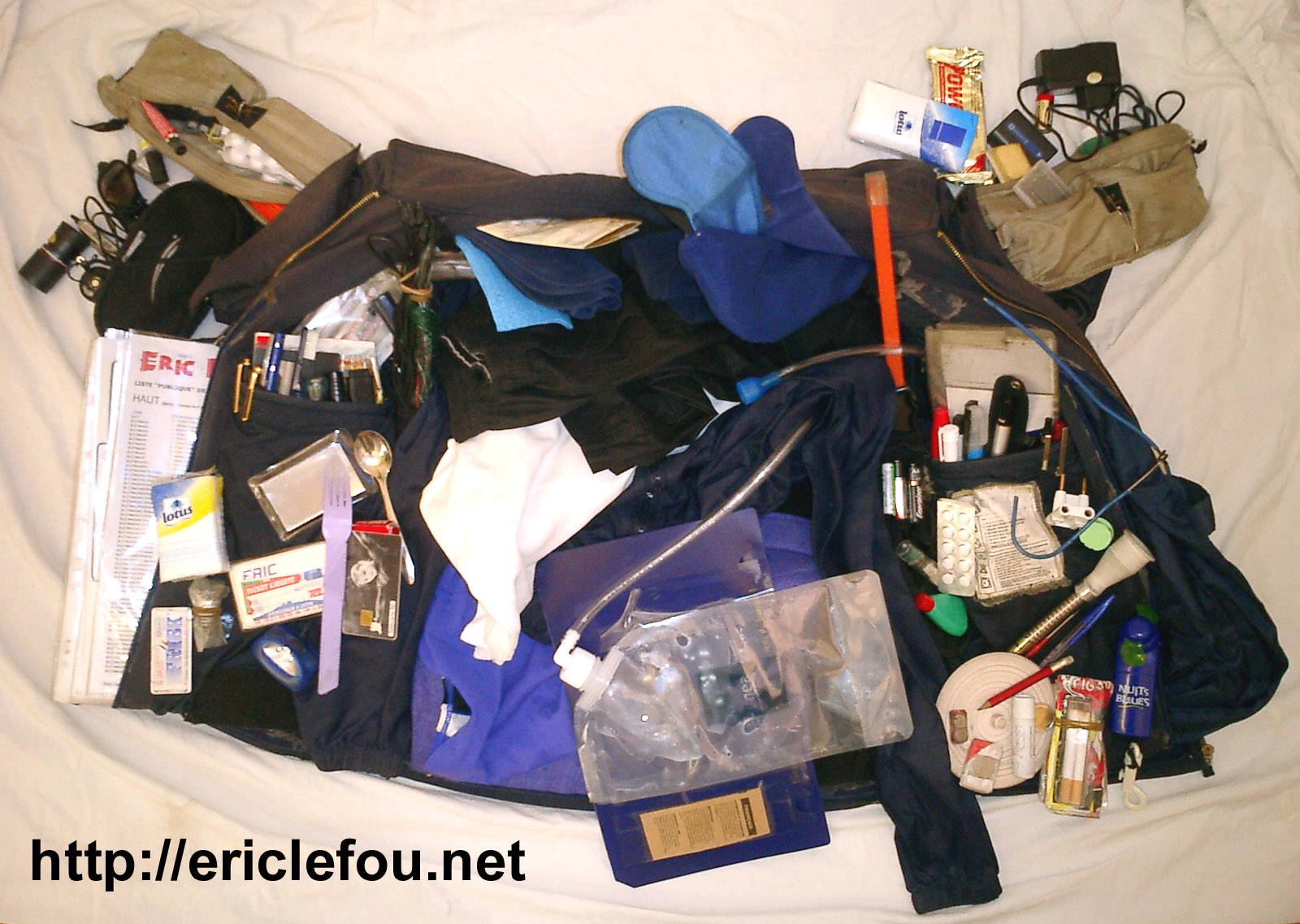
Quoth le fou:
“The weight is 15 kg of clothes, including 12 kg of objects : it seems heavy but actually I do not feel it when walking (I walk a lot) because it is placed all around the body and there are not many “forces” (physics law…) (except if I must climb many stairs), and also I’m used to this (maybe a little muscled now…).
Apart from friends, family, colleagues (and now TV viewers…), nobody knows that I carry all this, I mean that in the street or in public transportation, nobody notices me, hopefully ! (I’m not a clown and I have no time to waste on explanations for people in the street, I prefer to do this once for all : websites are made for this !).
The count of 1300 items can be verified on my site since I provide Excel (.xls) lists. My aim is not to tell all the world about my life, but if I tell some things, at least I don’t want to be considered as a liar… The average weight is very small (about 10 grams), simply because there are many small things that weight nearly nothing (like paperclips, pins, cards, sheets of paper, wires, elastic bands, handkerchiefs and so on) but such items are not here only to increase the count, there is only what’s necessary.” - Eric’s website, which has lists and lots more info
Frank@OBOW
Most of Eric’s site info dates back to 2003 or 2004. Who knows if he’s still fooling around in this wa? Maybe the burden became too great.
April 21, 2010 Chicago Tribune travel editor goes personal-only with help from a ScottEVest jacket:
When Spirit Airlines broke new ground by announcing that it will charge passengers $45 for carry-on bags starting Aug.1, I took it as a personal challenge. I had to prove I could travel without even a carry-on.
The answer is in what the airlines call a “personal item.” That typically is a briefcase, purse or, in Spirit’s case, its Web site even shows a small backpack. To prove my case, I used a Case Logic bag measuring a mere 13 by 9 by 4 inches and an SeV/Scottevest Pack Windbreaker, with its 17 pockets ($75 from scottevest.com). — full story
And, yet another editorial in favor of carry-on fees, accompanied by an online poll you can weigh in on.
February 27, 2010  Tyler Brûlé (he of the fabulous lifestyle) is rethinking his luggage strategy. Wheels and - gasp - possibly even a baggage claim ticket beckon.
“You do know that one of the easiest routes to back injury is placing bags into overhead luggage bins when you fly,” said Doktor George. “You should really make sure you take care as it’s so easy to throw your back out.” “What are you suggesting, then?” I asked. “It might be time to rethink your luggage,” he said.
At this point I think my eyes might have narrowed as I stared at Doktor George. I was trying to read what the good doctor was suggesting and whether he was baiting me in jest or serious about a complete rethink of my no checked luggage, no carry-on wheely-bag policy.
“Definitely something to think about for 2010,” I said with a smile.- ft.com
TB promises a conclusion to this quandry next week. In the mean time I must say again, going one-bag is a bad idea if that one bag is too heavy. Maybe that’s the point of the above-quoted exchange. Take the 10%-of-body-weight rule seriously unless you’re quite fit and quite young!
December 8, 2009 Go, See, Run, Eat, Drink is one woman’s account of a year of one-bag world travel. Here’s the midway gear update.
Some of her numbers:
Oh, and her bag is an Aeronaut. See this post for packing info.
