Entries in Clothes for Travel (17)
I’ve previously reviewed the ExOfficio Air Strip Lite shirt and it’s a winner. It’s pricey so look for a sale. I’m less impressed with ExOfficio’s vaunted travel underwear. The men’s boxer variety - at least in my case - came oversized; they were the blousiest, largest mediums I’ve ever seen. This led to a good deal of bunching and discomfort. The fabric had more of the tacky, polyester feel when sweaty than I expected. My old Terramar Visaendurance briefs were much more comfortable and more odor-resistant. Alas, a far-sighted sock fairy made off with them and they’re no longer available. This looks like the replacement though: Terramar Underwear Boxer Briefs - with EC2 and 4-Way Stretch (For Men).
I’m still looking for a really good pair of quick-dry pants for travel. Polyester and microfiber leave something to be desired - and often leave something to be smelled too. Orvis has new pants in a nylon canvas fabric that might be the answer. I’m beginning to think that tropical-weight wool pants, which can be worn a few times at least without getting funky, are the best three-season solution. Just hang up and air out the wool slacks and they’re usually good for another day.
OBOW reader Sam (see comment below) gives a strong recommendation for the REI Adventures Pants. They look good to me. Unlike a lot people I can’t bear the zip-off leg, heavy cargo look. I’m too old I guess…
I just picked up a six-pack of premium 100% cotton undershirts for everyday wear and was struck by how heavy they were. The six of them weighted two pounds. No wonder I carry only two or three poly/nylon quick-dry undershirts when I travel. Two pounds would amount to about one-fifth of my normal load for a trip of up to 10 days. Two synthetic shirts (which can be laundered in the sink every night or so) weigh eight ounces or less. It’s not just pants and shirts - which you can often wear two or more times without washing - that weigh a suitcase down. Carrying a daily change of cotton underclothing may make you fill good all under but may be hard on your back or shoulder. Think synthetic. But be choosy: the worst of the poly/nylon undies can be brutally uncomfortable. The good ones are a delight.Joe Brancatelli is a gem. His advice is always witty and wise. Joe on dressing for checkpoint success:
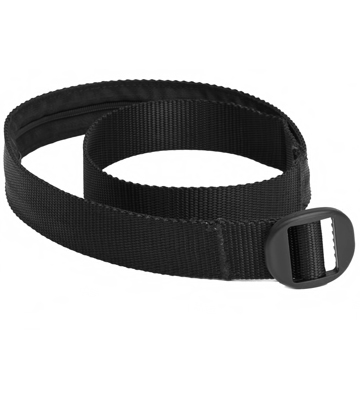
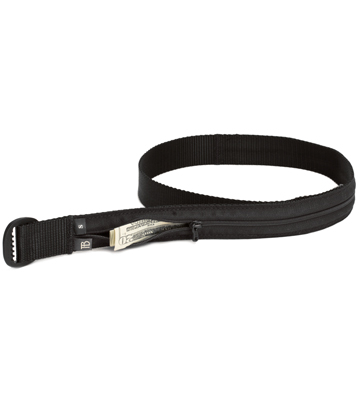
“I’ve found that the fastest way through security is to go plastic. I switched the brass buttons on my blue blazer for plastic ones. I bought a plastic Swatch watch specifically for road trips. I’ve even gotten rid of my belt. Needless to say, I wear only slip-on shoes, and I check my socks for holes before I leave home.
“I won’t argue that this all sounds a bit unstylish. If you want to don jewelry, sport your favorite chunky metal watch, and wear your lucky running shoes, and if you really need a belt, do what I do: Stow these possessions in your carry-on bag, then put them on once you clear security. And here’s an incredibly useful tip: Stash potentially problematic items in zip-top plastic bags. Before you reach the checkpoint, dump everything-keys, jewelry, pens, handheld computers, cell phones, loose change-into a bag and place it in an exterior pocket of your carry-on. When you escape the clutches of the T.S.A., fish out the zip-top bag and return everything to your person.” - washingtonpost.com
More tips from Joe on minimizing your sartorial load:
- Limit your color palette so your clothes match easily - maximizing their utility
- Accessorize - create the illusion of more outfits with different ties, scarves, etc.
- Buy clothing on the road
- Use hotel laundry services - “Lugging around dirty laundry is, needless to say, counterproductive.” (I might add that the non-business traveler can easily wash their own clothes in-room, provided you’ve chosen the right clothing)
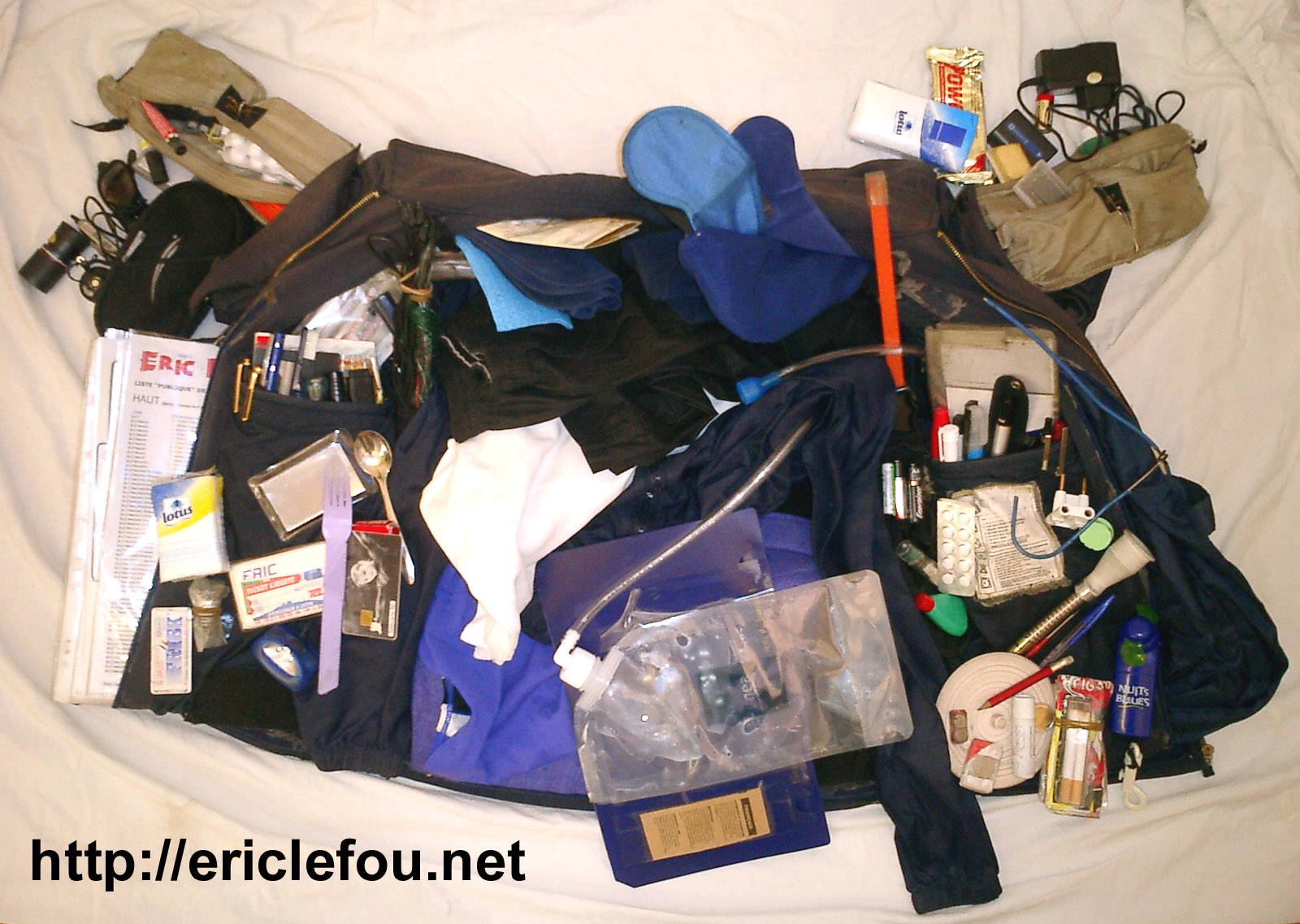
One way to pack lighter is to wear what you might otherwise stuff in a bag. SCOTTEVEST “gear management clothing” allows you to get lots of tech gear out of your bag and into your jacket or vest. They have some interesting stuff. The pants wouldn’t do you much good at the security checkpoint since you have to empty your pockets anyway, but a jacket can be removed and sent through the x-ray machine. Subracting the weight of your phone, iPod, PDA, AC adapters or chargers from your carryon might help you beat some of the tough new carryon weight limits.
The Washington Post travel blog has a nice short piece on how ridiculous and old most “travel” clothes look, citing Magellan’s, Travel Smith, and Land’s End as examples. I couldn’t agree more. And what about the Tilley hat? Is anything more ridiculous looking? I love those guys with their multi-pocket travel/photo vests and Tilley lids. Maybe we’ll all be there one day, but I agree that there’s a need for something between old person and hostel-bound hiker fashion. ExOfficio, Royal Robbns, and Columbia are probably the best place to look for a middle ground. You may also find that “regular” clothes work well for travel. I have a normal poly/cotton dress/casual shirt that dries as fast as any tech shirt. Wool and wool-blend stuff is great too.OBOW has picked up lots of new readers in recent weeks so it’s time to for a little re-posting. Here’s our original post on a travel laundry technique we developed - with a little further development tacked on at the end:
Doing laundry on the road is one of the necessities of light, one-bag travel. You don’t need ten changes of underwear for a ten-day trip; you can get by with three. But, you must use synthetics to successfully wash and dry overnight in the hotel room or hostel. Therein lies the problem: Synthetics get stinky fast. One solution is to pay $18-$35 for high-tech underclothing which has fabric with built-in anti-microbial (and, hence, anti-odor) properties.
I have discovered another, cheaper way: Sink wash your garden-variety synthetic (polyester/nylon) undies using my odor-fighting concoction.
Here’s how you do it. Fill the sink about half way with lukewarm water. Mix in a couple of glugs of clear Softsoap antibacterial handsoap and a couple of spritzes of Febreze Anti-Microbial. Handwash the undies, then rinse them out quickly - not too aggressively. Apparently enough of the anti-bacterial and anti-microbial stuff stays in the fabric to make it perform like the $25 hi-tech variety. My $10 Champions now finish a sweaty day as sweetly as my more-expensive Terramar briefs (with Visaendurance wonder fabric). This formula makes the high-tech fabrics work even better. The anti-microbial fabrics are still preferable for backpackers who may have nothing more than a creek to wash in or who want to stick with a green, biodegradable detergent - which my formula isn’t. But, for the cost-conscious light traveler my method may be just the ticket. This method works equally well for briefs or undershirts. I’ve used it on my ExOfficio Air Strip shirt and microfiber pants too.
I get this stuff through the carryon screeners by filling two 2-ounce hand sanitizer bottle with the soap and a 2-ounce spray bottle (half-full) with the Febreze. This is enough for ten days or so. I don’t mix it together until it hits the sink.
DISCLAIMER: I cannot guarantee that this method will not harm or shorten the working life of some garments, but I have no reason to believe that the method is detrimental to any fabrics or finishes.
UPDATE: I am more convinced than ever that this is an effective method for washing travel clothing and minimizing your, er, aroma. It also works well in a washing machine using the gentle cycle and an appropriate water level. You’ll have to estimate the amount of soap and Febreze required, but keep in mind it’s not rocket science and it doesn’t take that much soap.
I’ve become aware Win High Performance Sports Detergent which I thought might perform similarly to the Stinkfighter formula. I cannot recommend it. My tests indicated that synthetic clothing was about as smelly after use with Win as with normal detergent. It may do a better job cleaning clothes with heavy embedded odor, but it does not work as well as my formula for the lightpacking traveler. And it’s quite expensive at $6 or $8 for a small bottle. You can find it at sporting goods stores.
Here is yet another way of accomplishing the goal of less smelly clothing recommend by OBOW reader Dan P.:
“I use a similar method. Good to know I am not the only one without $30.00 shorts. However, I do use a different set of ingredients. I use Scent-a-way laundry detergent to wash, then lightly rinse in a sink of water mixed with a cap full of X-O deodorizer. I agree with Brad the method works because the ingredients are not totally removed from the clothing. Scent-a-way is used by bow hunters and is designed to remove human scent and X-O is made for animal use which means both are strong but will not cause skin rashes. The only downside is I have a strong urge to urinate on fire hydrants ;-}.An extra plus is that both ingredients are environmentally friendly.”
I haven’t tested Dan’s formula but it sounds like it would work as well. Let us know what works for you.
The warm weather traveler would do well to consider wool socks for four-season use. Even in the summer mid- to lightweight wool socks provide an excellent combination of durability, blister prevention, natural odor protection, and comfort. This is something most hikers, bikers, and runners already know. The key is wool’s moisture wicking qualities means you feet stay drier, which helps prevent blisters. I did a June trip where I walked about ten times more than normal without a single blister. But aren’t they hot? Not in my experience, but as with all travel clothing you should test your gear before you go — under similar conditions if possible.
Socks designated as “light hikers” are usually appropriate for summer. I find that about three pairs of wool socks will get me through a trip of any length. And if you like to look snazzy, Smartwool makes some really cool color combinations.
Disposable cotton Onederwear is an interesting option for the light traveler. I tested the men’s boxers on a recent trip and found them to be a viable alternative to traditional cotton or poly underwear. I used them about three days out of eleven on this trip including the last day — which meant wearing them a full 24 hours from hotel departure to arriving home in the early hours of the morning. In between were 10 hours of flights, three airports with lovely vinyl seating, 13 hours of layover and flight delay, and an hour in a car or bus.
The Onederwear boxers are not perfect but they are surprisingly comfortable. My concern was that their thin waistband would pose a problem but this proved not to be the case — my undershirts stayed tucked and the briefs stayed “up”. The boxers’ fly is a little more problematic. It seems not to overlap far enough and after a long day the barn door is a little ajar, if you know what I mean. Nevertheless, I found their comfort to be comparable to the poly/nylon boxers I was wearing on other days. Onederwear makes boxers, briefs, and three types of women’s underwear. (I also received some briefs. I didn’t care for their fit, but then I rarely like briefs. The briefs did have a more effective fly than the boxers.) Another note: because their cotton fabric is quite thin they dry quicker than traditional cotton underwear if they become sweat soaked.
Even if they do not become your primary choice for travel underwear, keeping several pairs on hand is a good idea — for those nights when you’re tired of sinkwashing, or to keep in your day bag or vehicle in case of accident, illness, or unexpected travel delays. I’ll continue to use them along with my poly quick drys.
At about $2 per pair including shippng Onederwear may be cheaper for the occasional traveler than buying two or three pairs of Tilley or Ex Officio travel undies. Since they’re made of cotton — and even though you throw them away — I’m guessing the environmental impact is no greater than that of poly underwear which is petroleum-based.
BTW - This company makes also makes a cool (if you need it) roll-up necktie case and disposable sheets to cover airplane seats for you germophobes. See these items here.
Paring down the weight and bulk of the travel wardrobe is what going light is all about, and it’s achieved not just by carrying fewer pieces of clothing. The clothing chosen needs to weigh less than our everyday duds. Pants - men’s or women’s - are a great place to start. Case in point: A pair of cotton denim jeans in my size weighs 28 ounces, a pair of cotton khakis weighs 18 ounces, and a pair of polyester summer-weight slacks comes in at 12 ounces - that’s 42% as heavy as the jeans. And, the polys will dry overnight; the jeans might never dry in some climates. Obviously, to go light, the place to start is below the belt.
The most powerful piece of clothing in the male traveler’s wardrobe is a good sport coat. This doesn’t apply to 20-something hostel-stayers and backpackers, but for most men, in most parts fo the world, a nice coat is a real plus. In Europe, where standards of appearance are often higher than in shorts-and-flipflops America, the sports jacket may ensure higher regard and better treatment for the wearer. It will get you in most restaurants, art galleries, and churches with no discomfort. A well-chosen coat can also double as a raincoat and provides a hedge against rapidly changing weather. There’s a reason why so many gentleman dress the way they do in the UK; they simply cannot trust the weather. And they like to look good.Here’s my latest light packing list. Please send your own suggestions or your complete list so I can publish them on this blog.
Packing light means taking fewer clothes, which means washing them as you go. Any discussion of travel clothing and laundry involves unpleasant discussion of odor and the results of the dreaded sniff test. Please forgive all such comment found on this site. It is necessary. That being said, the more testing I do on the Incredible Stinkfighter 1.0 homemade sink-wash laundry formula, the more convinced I am of its effectiveness. It turns ordinary poly/nylon underwear into high-performance anti-microbial underwear that doesn’t stink at the end of the day. Since travel is about spending time in close quarters with people you know and meeting new people you don’t know, odor reduction is definite plus, even if it makes for unpleasant, travel-geeky conversation.
The Ex Officio Air Strip Lite shirt is recommended by many serious travelers. The 80% polyester/20% nylon fabric dries quickly and shows few wrinkles after a sink wash. The fabric is soft, has a nice hand, is very comfortable, and doesn’t wear blisters on your neck like some “travel” shirts do. An adjustable back vent and slits on the sides with mesh lining make it a perfect choice for mild or hot weather. The fit is excellent and it stays tucked nicely, if you’re a tucker.
My ony quibbles are that the pockets are placed a little too low on the chest and that the pocket gussetting is too baggy. The Air Strip Lite is available for men and women, in long and short sleeves. I prefer long sleeves even in the summer to protect from the sun and from overly-aggressive air conditioning (I’m cold natured). I bought mine when a local store put it on the end-of-winter sale rack because it had long sleeves, but it’s definitely no winter shirt.
Doing laundry on the road is one of the necessities of light, one-bag travel. You don’t need ten changes of underwear for a ten-day trip; you can get by with three. But, you must use synthetics to successfully wash and dry overnight in the hotel room or hostel. Therein lies the problem: Synthetics get stinky fast. One solution is to pay $18-$35 for high-tech underclothing which has expensive fabric with built-in anti-microbial (and, hence, anti-odor) properties.
I have discovered another, cheaper way: Sink wash your garden-variety synthetic (polyester/nylon) undies using my odor-fighting concoction. Here’s how you do it. Fill the sink about half way with luke warm water. Mix in a couple of glugs of clear Softsoap antibacterial handsoap and a couple of spritzes of Febreze Anti-Microbial. Handwash the undies, then rinse them out quickly - not too aggressively. Apparently enough of the anti-bacterial and anti-microbial stuff stays in the fabric to make it perform like the $25 hi-tech variety. My $10 Champions now finish a sweaty day as sweetly as my more-expensive Terramar briefs (with Visaendurance wonder fabric). The hi-tech fabrics are probably still a little better, and they are definitely still preferable for backpackers who may have nothing more than a creek to wash in or who want to stick with green, biodegradeable detergents. But, for the cost-conscious light traveler my method may be just the ticket. This method works equally well for briefs or undershirts. I’ve used it on my ExOfficio Air Strip shirt, too.
I get this stuff through the carryon screeners by filling two 2-ounce hand sanitizer bottlew with the soap and a 2-ounce spray bottle (half-full) with the Febreze. This is enough for ten days or so. I don’t mix it together until it hits the sink.
I haven’t been using this concoction long. Please let me know how it works for you. Your input may result in an even better Stinkfighter 2.0,
DISCLAIMER: I cannot guarantee that this method will not harm or shorten the working life of some garments, but I have no reason to believe that the method is detrimental to any fabrics or finishes.