Entries in Air travel news (90)
More first-class rage:
GEORGETOWN, Guyana (AP) — Guyanese authorities say a first-class airline passenger was so angry at seeing economy passengers leave a jetliner before him that he yanked open an emergency hatch and slid down the chute. - USA Today
And more from the airborne (or, in this case, stuck-at-the-gate) summer of love:
MYFOXNY.COM — A flight from Florida to New York Sunday night never got off the ground. That’s because after the flight crew arrived late, angry and impatient passengers got verbally agitated and hostile. Apparently it was so bad, the crew wasn’t comfortable working the flight so they refused to take off.
The predictions keep coming and they aren’t good:
Now that the airlines have hiked their checked bag fees — and have gotten away with it — prepare to pay for carry-on baggage.
That’s right. Carry-on baggage…
With delays inevitable with all the people fighting for overhead space, the airlines will be forced to start charging a carry-on fee for anything larger than a paperback novel. While the new fees have just been implemented, many are predicting chaos both during boarding and at the security lines.
Mark my words, this new fee will be spun as a way to speed up boarding time. The airlines will claim they are doing this to ensure on-time departures. - Ron Goltsch on Tripso.com
Another opinion piece if favor of fees for carry-on luggage:
It might make sense to limit the size of the checked bags or to charge for additional checked baggage — or even charge people for carry-on luggage. Checked baggage is considered pretty safe, whereas carry-on luggage has to go through extra screenings. It makes more sense to charge for carry-on bags than checked baggage. - EnidNews.com
American plans to more aggressively pull customers aside at boarding gates if the airline thinks they have too much carry-on baggage, as well as step up announcements about size limits in gate areas and on airplanes. United says it is still formulating its plans, but may try to gate-check bags for customers in later boarding groups before boarding begins for fully booked flights.
All three airlines say it’s possible that metal templates - which prevent larger bags from making it through X-ray machines - will be reintroduced. That’s a tactic that angered many customers in the past and was eliminated when the Transportation Security Administration took control of screening after the 2001 terrorist attacks.”It’s something we’ve looked at in the past and may look at again,” says Mark Dupont, American’s senior vice president of airport services planning.’ - eTurboNews (underlinging my own - Brad)
A different take on the luggage squeeze:
Instead of charging for checked bags, airlines could probably raise more revenue and improve the quality of the flight experience by doing just the opposite: charging for carry-on luggage.
Under this arrangement, flyers determined to keep their bags within arm’s reach can pay a premium to do so. And those who want to save money can do so by checking bags free of charge.
Such price incentives would shorten security lines, bring order to boarding, and help bring out the humanity in all of us at airports. Imagine: Even late boarders (who are willing to pay) could find space in an overhead compartment – perhaps even the one above their own seat. - opinion piece in the Christian Science Monitor
It’s going to get worse. As baggage fees drive amateurs to carryon-only, get ready for the squeeze as the bins bulge. And watch the size of your bag - templates may be coming back:
All three airlines say it’s possible that metal templates — which prevent larger bags from making it through X-ray machines — will be reintroduced. That’s a tactic that angered many customers in the past and was eliminated when the Transportation Security Administration took control of screening after the 2001 terrorist attacks.
“It’s something we’ve looked at in the past and may look at again,” says Mark Dupont, American’s senior vice president of airport services planning.
United is in favor of bringing back templates, says Senior Vice President Scott Dolan, and US Airways Group Inc. President Scott Kirby says a return of baggage templates is “likely” at some airports. While security checkpoints are controlled by the TSA, airlines can pressure the federal agency to allow templates if a checkpoint serves a single airline, or several airlines with the same policy on templates. - WSJ/The Middle Seat
Can we expect a new crop of undersized carryons like the Tom Bihn Western Flyer?
Thanks to OBOW reader Kate for the heads-up on this story. I had heard a rumor of this a few weeks ago - weighing and charging for not just luggage but those who lug it as well:
Airlines have already rolled out an exhaustive list of more conventional levies, covering everything from food to fuel to check-in. So when executives gathered around the brainstorming table this time round, more exotic measures were forced into focus, or so say industry insiders Stateside. - Irish Indepedent
So be sure to pack your plate on the light side as well.
American Airlines has apparently decided to get serious about carryons now that their “charge for checked” program has gone in to effect. How convenient.
At security: American will have employees monitoring customers carry-on bags to ensure that just one carry-on and one small item are being taken through the checkpoint. Passengers with too many items, or bags too large to carry on, will be assisted in checking their luggage. At the gate: Employees will again monitor carry-on bags to make sure passengers are following the rules. If the airplane runs out of overhead space, travelers can check their carry-on bags at the gate without charge. Passengers who bring oversized luggage to the gate, however, will have to pay the fee to check the items.
As usual, the problem won’t be the savvy light travelers but the guy who wants to save $25 and still bring everything he can stuff into his 25-inch long rolling case. As the bins fill up, soft-sided carryons of the proper (or smaller) size are more important than ever.
As travelers have adjusted to the carry-on liquid rules the overhead bins are back at full capacity. This definitely commends soft-sided, legal-or-smaller-sized bags:
On her US Airways flight from New Orleans to Washington in March, Corinne Marasco, a science writer from Kingstowne, Va., was forced to check her small wheelie bag at the gate because no room remained in the overhead bins.
It didn’t matter that the gate agents kept reminding passengers that they were limited to one item of carry-on luggage, plus one personal item; the overhead bins were stuffed with shopping bags, knapsacks and pieces of luggage that clearly didn’t pass the size test.
“I saw a woman with a roll-on suitcase, a medium-size tote bag and a pocketbook board the plane, and no one asked her to check the suitcase,” Marasco said. “I was sorely tempted to start emptying out the bin over my seat so I could fit my suitcase in. - NYT via Kansas City Star
The above story also suggests that the fees airines are levying for checked luggage is driving more inexperienced, rule-flouting flyers to carry on.
DHS Announces New Aviation Security and Traveler Screening Enhancements
April 28, 2008
BALTIMORE– The U.S. Department of Homeland Security (DHS) announced today improvements aimed at strengthening aviation security while decreasing the hassle factor for travelers. Among the key improvements, DHS is providing airlines more flexibility to allow passengers to check in remotely who have been unable to do so because they have a name similar to someone on a watch list. The department also unveiled the Checkpoint Evolution prototype, which begins full operation at Baltimore-Washington International Airport (BWI) today.
Each airline will now be able to create a system to verify and securely store a passenger’s date of birth to clear up watch list misidentifications. By voluntarily providing this limited biographical data to an airline and verifying that information once at the ticket counter, travelers that were previously inconvenienced on every trip will now be able to check-in online or at remote kiosks.
“Hassles due to misidentification and the resulting necessity to stand in line to check in at the ticket counter is consistently among the deepest – and most valid – complaints of the traveling public,” said Homeland Security Secretary Michael Chertoff. “Thousands of passengers are inconvenienced each day, and this change should provide a way to eliminate the vast majority of these situations. This is good for travelers and for security, because as we make the checkpoint environment calmer, it becomes easier to spot individuals with hostile intent.”
Additionally, DHS is providing greater clarity on the types of identification that will be accepted at checkpoints in the U.S. Beginning May 26, 2008, federal or state-issued photo ID will be accepted if it contains: name, date of birth, gender, expiration date and a tamper-resistant feature. Standardizing the list of accepted documents better aligns TSA with other DHS components and REAL ID benchmarks. More information on acceptable documents is available at www.tsa.gov.
These innovations, along with the new Checkpoint Evolution prototype, are part of a broader effort to calm the checkpoint. The BWI prototype includes Millimeter Wave technology used in random continuous use, multi-view X-ray and liquid bottle scanners. These technologies, in conjunction with changes to the checkpoint environment and processes, will be evaluated for operational efficiency over the coming months.
Transportation Security Officers and managers at BWI are the first in the country to complete a 16-hour training module designed to incorporate the latest intelligence analysis, more advanced explosives detection skills, and ways to engage with passengers to promote a calmer environment for better security. The training was developed by the Transportation Security Administration (TSA) Office of Intelligence, Bomb Appraisal Officers, and TSA Checkpoint Evolution team.
Checkpoint Evolution is located at B Checkpoint, Southwest Terminal at BWI. The layered security elements are both modular and flexible and designed to work individually, as well as part of an integrated package.
The Millimeter Wave is about to hit both coasts:
TSA Announces Bi-coastal Launch of Millimeter Wave Imaging Technology
Press Release
TSA Public Affairs
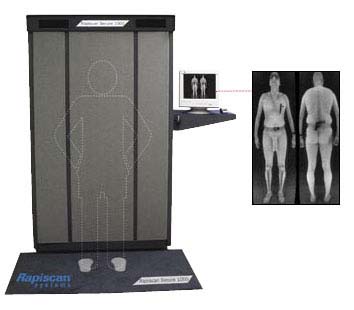
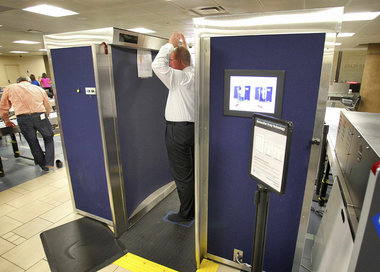
WASHINGTON – The Transportation Security Administration (TSA) announced today pilots of millimeter wave technology to Los Angeles International Airport (LAX) and John F. Kennedy International Airport (JFK). Millimeter wave is currently in use at Phoenix Sky-Harbor International Airport. Millimeter wave detects weapons, explosives and other threat items concealed under layers of clothing without any physical contact. It is a promising alternative to the physical pat-down.
“The use of whole body imaging is a significant step forward in checkpoint technology,” said TSA Administrator Kip Hawley. “By expanding the use of millimeter wave, we are providing our officers with another tool to enhance security and protect the public from evolving threats.”
At LAX, millimeter wave will be used in a random continuous protocol. Alternative screening measures will be offered to individuals who decline to go through millimeter wave when asked to do so. The LAX pilot enables TSA to examine millimeter wave’s operational capability, throughput, training, ease of use and privacy perceptions by the traveling public. The metal detector will remain in place at the checkpoint. The passenger will pass through it after going through the millimeter wave machine.
Millimeter wave at JFK will be piloted as a secondary screening device similar to its use in Phoenix. The technology is a voluntary alternative to a pat-down during secondary screening. During the Phoenix pilot, 90 percent of passengers have chosen the technology over the traditional pat-down.
In both locations, a transportation security officer will guide passengers through the process, which involves stepping into the machine and remaining still for a matter of seconds while the technology creates a three-dimensional image of the passenger from two antennas that simultaneously rotate around the body. Once complete, the passenger will step through the opposite side of the millimeter wave portal.
To ensure privacy, security officers view images from a remote location. From this location, the security officer cannot ascertain the identity of the passenger, either visually or otherwise, but can communicate with a fellow officer at the checkpoint if an alarm is presented. A security algorithm will be applied to the image to blur the face of each passenger, further protecting privacy.
Millimeter wave uses electromagnetic waves to generate an image based on the energy reflected from the body. Active millimeter wave technology passes harmless electromagnetic waves over the human body to create a robotic image. It is safe and the energy emitted by millimeter wave technology is 10,000 times less than a cell phone. TSA recently announced it will purchase and deploy 30 more of the machines this year.
TSA blog defends the Wave:
As a married father of five small children, I wouldn’t think twice about sending my wife, my four boys or little girl into this machine. I’ve seen the image it produces and I am not only confident as a TSA employee - but as a citizen - that TSA has done everything possible to address passengers’ privacy concerns regarding whole body imaging.
For those of you who remain skeptical, you’ll be happy to know that, as we expand the use of whole body imaging to JFK and LAX, it remains an optional screening method for passengers. It’s voluntary so if you’re selected for additional screening and you prefer the physical pat-down, just let our officers know. - read the whole post here and don’t miss the comments!
What’s a major international air carrier to do when its high-tech terminal of the future crashes? Call FedEx and truck some of the bags to another airport for security screening!
British Airways canceled 50 flights at London Heathrow airport’s new Terminal 5 and hired FedEx to carry about 20,000 pieces of luggage to the airport to reunite the bags with passengers after nearly a week of disruption at Europe’s busiest airport.
Glitches in the $8.5 billion terminal’s computerized baggage system have caused more than 300 flight cancellations since the system’s March 27 startup. British Airways says it has been able to return about a third of the bags to their owners.
The airline had been counting on Terminal 5, which took two decades to plan and build, to cut down on congestion and ease operations at Heathrow.
But the high-tech computerized luggage system refused to allow handlers to log-on, meaning bags that have been unloaded at Heathrow have to be re-screened manually. Some of the bags had to be taken to London Gatwick airport for the security checks. - Air Cargo World
The New York Times has an interesting story on the regular disregard of carry-on luggage rules - and the fact that it’s getting worse thanks to 3-1-1. Delta Airlines is taking steps to crack down:
The carry-on wars have gotten so out of hand that at least one airline has begun to crack down on rule-breakers. This month Delta Air Lines began requiring that all carry-on items be tagged with a special approval tag before passengers board any international flight.
“We did see a need to better enforce the carry-on allotment for international flights,” said Betsy Talton, a spokeswoman for Delta. “We are looking to make sure there is enough overhead space on international flights.”
Who is to blame for the overhead crunch? The Transportation Security Administration, which performs security screenings of passengers and bags, says it is up to the airlines to enforce the carry-on rules. Airlines, for their part, say their gate agents and flight attendants are responsible for ensuring that passengers don’t abuse the rules. But the rules, as any traveler can attest, are rarely enforced consistently. - NYT
I’ve never gotten on flight where many of the carryons (often rollers that appear to weigh 30 pounds or more) weren’t obviously beyond the stated limits. And inexperienced travelers often aren’t to blame: lots of carryons are disingenuously marketed as being “legal” when in fact they are not.
The Heathrow story is just too compelling to drop. LHR is simply the focus of evil in the modern travel world, and it’s the best conceivable argument for NEVER checking a bag:
Last night, hundreds of passengers were forced to sleep at the terminal after waiting for their luggage for up to six hours.
By 4am queues of hundreds had formed, with airport officials handing out boxes of blankets, sleeping bags and bottled water.
Tempers boiled over and some passengers were close to tears when they were told 75 flights had been cancelled today - some for the second time in 24 hours.
By noon, the situation had become so bad that the union representing BA staff was forced to issue a statement asking angry passengers not to abuse or attack staff. - thisislondon.co.uk
Where’s the UN High Commissioner for Refugees when you need him? This is astounding. The story quoted above has some classic lines: “national disgrace and a national humiliation,” “forced to stuff her wedding dress into her hand luggage,” “one of the worst days in history,” “I am embarrassed as hell to be a British citizen.”
The failed baggage-handling system has 10 miles of conveyor and 140 computers to make it work. Parking spaces may have been the ultimate problem. The fiasco started when much of the baggage-handling staff were late for work because the new terminal didn’t allow for enough employee parking.
It all got worse: 15 of 16 elevators weren’t working. With classic British understatement, one official said, “It was disappointing that the opening day was marred by operational difficulties.”
More from Bloomberg
UPDATE - latest news here
British Airways vaunted Terminal 5 (recently opened by the Queen) was supposed to alleviate some of the chaos and congestion that is London’s Heathrow. Well, it didn’t work. The terminal crashed Thursday and today, or at least its incredibly complex subterranean luggage handling system did. Twenty percent of BA’s flights were canceled and guess what - no checked luggage, If you flew ouf of 5 it was carry-on only. Share this story with your friends who think you’re a ridiculous travel geek/luggage freak!
Some excerpts from RTTNews:
News release from Northwest Airlines:
EAGAN, Minn. – (March 28, 2008) – Northwest Airlines (NYSE: NWA) today announced changes to its luggage policies for coach class customers traveling within North America.
For coach class travel on or after May 5, 2008, Northwest Airlines is matching several other U.S. network carriers and implementing a $25 charge for the customer’s second checked bag. The fee is applied each way. Coach class customers may continue to check one piece of luggage free of charge.
Other changes include an increase from $80 to $100 for three or more checked bags, and an increase from $25 to $50 for overweight bags greater than 50 pounds.
These policies also apply to Northwest Airlink customers flying on Mesaba, Pinnacle or Compass Airlines.
Northwest Airlines’ Silver, Gold and Platinum WorldPerks® Elite customers, SkyTeam Elite customers and passengers booked in full fare classes (Y or B) may still check two bags free of charge. Customers booked in first class can continue to check up to three bags free of charge.
Rumor is that American Airlines may implement a similar policy.The day isn’t far away when airlines will be charging for all checked luggage, not just the second piece.